


 中文简体
Stainless steel piping systems rarely fail because someone picked the wrong pipe. More often the trouble starts at the joint — an elbow that pits, a flange face that weeps, or a threaded coupling that cracks after a few thermal cycles. That is why 316 stainless steel pipe fittings deserve a closer look early in a project, not after the bill of materials has already been frozen.
In this guide we walk through what the 316 grade actually brings to a fitting, how it differs from 304 and 316L, which fitting families are commonly stocked, and the practical details — standards, schedules, certificates — worth confirming before you place a purchase order.
What Makes 316 Stainless Steel Pipe Fittings Different
Type 316 is an austenitic stainless steel built on a familiar base: roughly 16 to 18 percent chromium, 10 to 14 percent nickel, and a small but decisive addition of 2 to 3 percent molybdenum. That molybdenum is the headline. It reinforces the passive chromium oxide film that protects the surface, particularly in chloride-bearing environments where pitting and crevice corrosion usually begin.
The difference is measurable. Using the pitting resistance equivalent number — PREN, calculated as chromium plus 3.3 times molybdenum plus 16 times nitrogen — 316 typically lands around 24 to 26, while 304 sits closer to 18 or 19. In everyday terms, that gap shows up as fewer pits in coastal air, brackish cooling water, and chemical process streams that would slowly chew through a 304 joint.
Mechanically, annealed 316 is close to 304, with tensile strength around 515 MPa and yield strength near 205 MPa, plus good ductility and toughness that hold up down to cryogenic temperatures. It also retains strength better than 304 as temperatures climb, which is why it appears so often in steam lines, heat-exchanger circuits, and hot process piping.
Where it stops matters just as much. Concentrated chlorides at elevated temperature can still trigger stress corrosion cracking in 316, and hot, strongly oxidizing or reducing acids may call for a higher alloy such as a nickel-based grade. Being honest about those limits at the design stage saves a great deal of rework later.
316, 316L, or 304: Choosing the Grade for the Joint
Most specification arguments come down to three austenitic grades. The table below compares them on the points that actually drive a purchasing decision.
| Property | 304 | 316 | 316L |
|---|---|---|---|
| Molybdenum | None | 2–3% | 2–3% |
| Typical PREN | 18–19 | 24–26 | 24–26 |
| Maximum carbon | 0.08% | 0.08% | 0.03% |
| Typical yield strength | 205 MPa | 205 MPa | 170 MPa |
| Chloride service | Moderate | Good | Good, with better weld-zone resistance |
| Usual application | General indoor and domestic | Chemical, marine, process | Welded process lines, pharma, food |
The L suffix is not a marketing detail. Capping carbon at 0.03 percent prevents chromium carbide from precipitating in the heat-affected zone during welding, which is exactly the mechanism that leaves a welded joint vulnerable to intergranular attack. The trade-off is slightly lower yield strength, so for high-pressure, unwelded assemblies, standard 316 can still be the better answer.
A simple rule of thumb we pass on to customers: if the line will be welded and then placed in corrosive service, specify 316L and match the filler metal to it, typically ER316L. If the fitting is threaded or socket-welded into a moderate-duty system, standard 316 is usually sufficient and a little more economical.
 Stainless Steel Pipe Fittings and Connection ComponentsCovers tees, flanges, reducers, elbows and caps in 304, 304L, 316 and 316L for corrosion-resistant piping connections.View Product →
Common Types of 316 Stainless Steel Pipe Fittings
A fitting is a small component with a large job: change direction, change diameter, branch a line, terminate it, or tie it into equipment. Most 316 fittings fall into a handful of recognisable families.
Butt-Weld Fittings
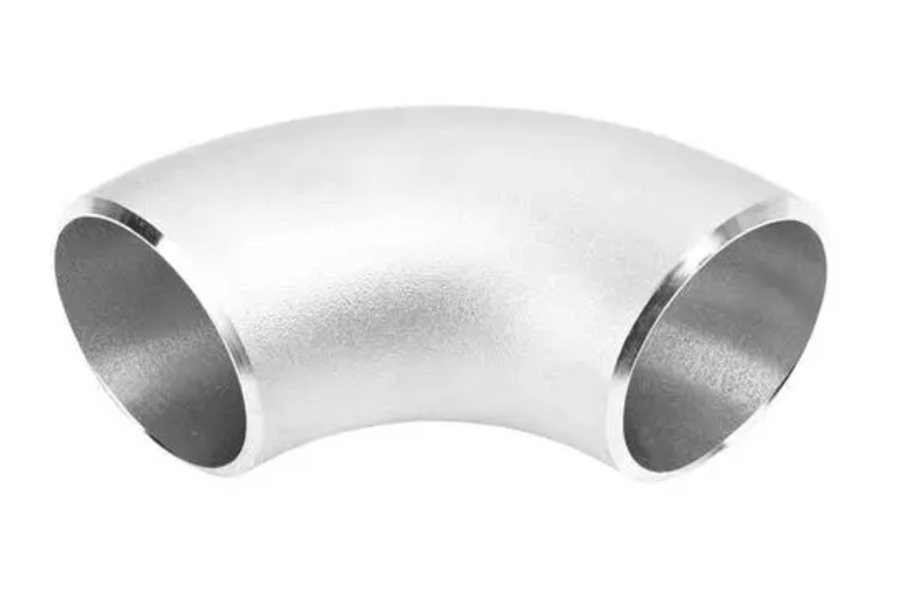
Ninety-degree and 45-degree elbows in both long and short radius, equal and reducing tees, concentric and eccentric reducers, caps, and stub ends. These are dimensioned to ASME B16.9 and welded permanently into the line, which gives the smoothest bore and the best fatigue behaviour — the reason they dominate process piping above roughly two inches.
Stainless Steel Elbow for Pipeline Direction ChangesStainless steel elbow for changing pipeline direction, offered in 304, 304L and 316L with 45°, 90° and 18° configurations and multiple finishes.View Product →
Flanges
Weld neck, slip-on, blind, lap joint, socket weld, and threaded flanges, dimensioned to ASME B16.5 up to 24 inches and available with raised face, flat face, or ring joint facings. Forged 316 and 316L flanges are normally ordered to ASTM A182 F316 or F316L, which is a different specification from the wrought fitting standard and worth stating explicitly on the enquiry.
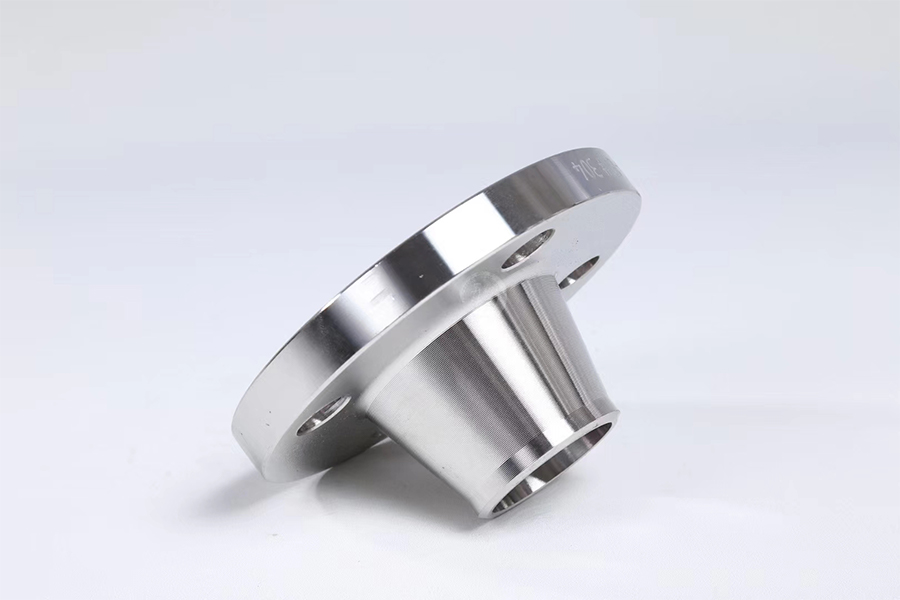 Stainless Steel Flanges for Piping ConnectionsStainless steel flanges in 304, 304L, 316L and other grades, including flat welded, butt welded, socket welded and threaded types for piping connections.View Product →
Threaded and Socket-Weld Fittings
Covered by ASME B16.11, these suit small-bore lines — usually NPS 1/2 to 2 — where welding on site is impractical or the joint may need to be broken later. Threads are commonly NPT or BSP, and thread engagement plus a compatible sealant matters far more than most people assume.
Sanitary and Special Connections
Tri-clamp, DIN 11851, and similar hygienic connections serve food, dairy, and pharmaceutical lines where cleanability is the governing requirement. Beyond the catalogue, long-radius bends, custom facings, and fabricated assemblies are frequently made to drawing for powder, slurry, and exhaust systems.
Standards, Schedules, and Sizes to Confirm Before Ordering
Fitting specifications are dense, but a few references cover most purchases:
- ASTM A403 / ASME SA-403 — wrought austenitic stainless steel piping fittings
- ASTM A182 — forged or rolled flanges, fittings, and valves
- ASME B16.9 — butt-weld fitting dimensions
- ASME B16.11 — forged socket-weld and threaded fittings
- ASME B16.5 — pipe flanges and flanged fittings
- EN 10253 and DIN 2605 — European dimensional standards
Schedule matching is where most costly mistakes happen. A fitting must match the wall thickness of the pipe it joins, so state the schedule clearly — 10S, 40S, and 80S are the common stainless choices. Butt-weld fittings are ordered by nominal pipe size and schedule; flanges are ordered by nominal size and pressure class, such as Class 150 or Class 300. Mixing NPS and DN conventions in the same enquiry is a reliable way to receive the wrong parts.
Where 316 Fittings Earn Their Keep
The grade tends to appear wherever chlorides, acids, or hygiene requirements rule out carbon steel and 304:
- Chemical and petrochemical process lines handling acids, solvents, and chloride-bearing streams
- Desalination and water treatment, including reverse osmosis skids and brine circuits
- Food, beverage, and dairy plants, where cleanability and washdown resistance are essential
- Pharmaceutical and biotech process pipework, often in 316L with polished internal surfaces
- Marine and offshore systems — seawater cooling, deck drains, exhaust, and ballast lines
- Pulp and paper mills, where chloride and sulphur-bearing liquors are aggressive
- Power generation and heat recovery, where thermal cycling punishes weak joints
A Practical Checklist Before You Place an Order
- Confirm the grade and carbon level: 316 or 316L, and match it to the pipe and to the welding procedure.
- State nominal size, schedule, and end type — butt weld, socket weld, threaded, or flanged.
- Request the material certificate, ideally EN 10204 3.1, with heat numbers traceable to the mill test report.
- Check the standard the item is manufactured to, since A403 and A182 cover different product forms.
- Confirm flange facing and gasket detail; a raised face and a ring joint are not interchangeable.
- Plan post-weld treatment — pickling and passivation restore the passive film that welding disrupts.
- Weigh lead time against quantity: standard items ship from stock, while odd radii, unusual schedules, and custom facings need production time.
Working With a Supplier Who Understands Material and Fabrication
A fitting is only as good as the material behind it, and the paperwork that travels with it. As a supplier that both trades raw stainless and fabricates to drawing, Wuxi Chengfeng Metal Technology keeps a material warehouse holding around 20,000 tons of coil, which shortens the gap between an enquiry and a shipped order for standard plate, coil, seamless stainless steel pipe, and fittings.
Just as importantly, the same team handles the non-standard side. Experienced welders and fitters assemble cylinders, tanks, ducts, and piping spools, while a dedicated inspection group checks dimensions, surfaces, and documentation before dispatch. That combination — stock material plus in-house fabrication — is why the company regularly supplies listed companies, state-owned enterprises, central enterprises, and foreign-invested manufacturers, and why a question about a specific joint usually gets a straight technical answer rather than a catalogue page.
If you are weighing options for a chloride-bearing line or a welded assembly, it is worth reading more about durable pipe connection solutions before finalising the specification.
Choosing 316 stainless steel pipe fittings is rarely about picking the most expensive option on the shelf. It is about matching the grade to the environment, the schedule to the pipe, and the documentation to the application. Get those three right, and the joints you never think about again are the ones doing their job properly.

